Choose your adventure
Game modes in Pokémon Quetzal
Pokémon Quetzal offers ten ways to play, from the classic experience to challenges involving randomization, permanent death or type restrictions. Learn the rules before starting a game, as some modes cannot be disabled afterward.
- Normal ModeThe classic adventure with predetermined encounters, items and teams.Read more ↓
- Random ModeRandom species, types, Abilities, moves and items.Read more ↓
- Nuzlocke ModeOne catch per route, mandatory nicknames and permanent death.Read more ↓
- RandomlockeCombines Random Mode's randomization with Nuzlocke rules.Read more ↓
- Variety ModeDynamic Double Battles without changing the route structure.Read more ↓
- Mirror ModeCopy your opponent's team and focus your strategy on your inventory.Read more ↓
- GlasslockeMirror battles with permanent defeat and random loot.Read more ↓
- MonotypeComplete the adventure using a single elemental type.Read more ↓
- RandomtypeA type restriction with random species and opposing teams.Read more ↓
- Cheat ModeAn experimental mode for exploring and testing the game.Read more ↓
Normal Mode
Normal Mode provides the classic Pokémon Quetzal experience without random elements. Wild Pokémon appear in fixed locations, Trainers use predetermined teams and battle mechanics work as standard.
- Starter Pokémon: choose from a wide variety of primary and secondary starters from different generations. All start at level 5 and have at least three perfect IVs.
- Wild Pokémon: each species appears in a fixed, canonical location. This mode is fully compatible with the DexNav.
- Trainers and Gym Leaders: their teams are predetermined and their levels scale with difficulty or rematches. Defeating them can unlock tutor moves and increase your party's level cap.
- Items: shops, NPCs and the first item Poké Balls on each map provide fixed items. Secondary item Poké Balls respawn after a set number of battles.
- Legendary Pokémon: they have fixed encounters and appear at levels 20–100 depending on story progress.
- Types and mechanics: uses the standard type chart and supports Mega Evolution, Terastallization, Dynamax and Gigantamax as normal.
Additional features
Fishing is automatic. Mega Stones are rewards from special Trainers or have a 30% chance of being held by the first evolutionary stage of a compatible wild Pokémon; DexNav chains can help you find them. Fossils can be revived without limit by the Devon Corporation scientists and, after the League, also appear at the top of the desert's Sand Tower.
Random Mode
Random Mode randomizes almost every element of the adventure. It cannot be disabled after starting a game, although its individual settings can be adjusted.
- Starters and wild Pokémon: any of the 1,025 Pokédex species can appear, including Legendary Pokémon. Their types, Abilities and moves are random.
- Evolutions: evolution lines can change or become blocked. The Pokédex shows what each Pokémon can evolve into.
- Trainers: they keep their appearance, but their teams, moves, types and Abilities are random. A species capable of Mega Evolution will hold its Mega Stone.
- Type chart: weaknesses and resistances change randomly in every battle.
- Items: items received or found on the ground are random, including Gems, Z-Crystals, Mega Stones and Tera Shards. Key Items are the only exception.
Shops and the activation of Mega Evolution, Terastallization and Dynamax work the same way as in Normal Mode.
Nuzlocke Mode
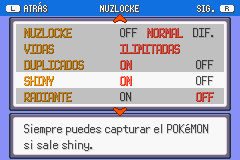
Nuzlocke Mode adds strict survival and permanent-death rules. It cannot be disabled after starting a game, although some individual settings can be configured.
- Catching: you can only catch the first Pokémon encountered on each route and must give it a nickname. Later encounters are only useful for battling or obtaining items.
- Permanent death: when a Pokémon faints, it is automatically sent to the PC and cannot be used again.
- Lives system: choose limited or unlimited lives when starting the game.
Difficulty levels
- Very easy: opponents are weak and your Pokémon always attack first.
- Easy: provides moderate difficulty.
- Normal: uses stat-based damage calculations and the standard catch rate.
- Hard: reduces the catch rate of the first encounter on each route, gives opponents held items and makes attack order depend on Speed 50% of the time.
- Very hard: opponents use competitive teams and AI and take less damage. If your Pokémon's level is lower than its opponent's, it always attacks last.
Randomlocke
Randomlocke combines Random Mode's full randomization with Nuzlocke's permanent death and restrictions. It is designed for Hard or Very Hard difficulty.
- Catching and battles: you can only catch one Pokémon per route. Teams, types, moves and Abilities change randomly in every battle.
- Special mechanics: opponents can activate up to three mechanics per battle and up to six in Double Battles. Your limit is three.
- Items: everything is random except Key Items. You cannot use healing items in battle.
- Death and defeat: fainted Pokémon are automatically released. If you lose a battle or run out of your configured lives, your save is deleted.
Variety Mode
Variety Mode preserves the normal game's routes and encounters but turns Trainer battles into Double Battles with teams that change in every encounter.
- Double Battles: all Trainers battle in pairs and can use Legendary Pokémon, Mega Evolution, Z-Moves, Terastallization, Dynamax and Gigantamax.
- Items and Eggs: ground items and NPC gifts are random. Eggs hatch into surprise Pokémon, including Legendary Pokémon.
- Experience: speed up training with x1, x2, x4 and x8 experience multipliers.
- Varied Routes: this option replaces the usual wild species with others that have equivalent stats and evolutionary stages.
Legendary Pokémon encounter methods and DexNav functionality remain unchanged.
Mirror Mode
Mirror Mode focuses on inventory management and tactical battles. You can enable or disable it at any time.
When a battle starts, you do not use your own party. Instead, you copy your opponent's Pokémon exactly, including stats, IVs, moves, held items and Terastallization. After battle, your previous party and status are restored.
Battle items in your Bag, such as Potions, status heals and X Attacks, are the main way to gain an advantage. Poké Balls, Mega Stones and evolution items have no practical use in these battles.
Glasslocke
Glasslocke combines Mirror Mode's copying system with a sudden-death format. In each battle, you copy your opponent's entire team.
- Opposing teams: Trainers use one to six Pokémon with random moves, types and Abilities that change on each rematch or restart.
- Permanent defeat: losing an individual Pokémon does not cost a life, but losing the battle deletes the entire save.
- Catching: you can only catch one Pokémon per route. Build your own party to earn money and items outside battle using Abilities such as Pickup or moves such as Thief and Pay Day.
- Items: all loot is random, and support items used in battle are decisive.
Monotype
Monotype challenges you to complete the adventure using only Pokémon that share the elemental type chosen at the start.
You can change your selected type during the game, but you must remove all Pokémon of the previous type from your party. Trainers, routes and other mechanics stay the same as in Normal Mode.
Randomtype
Randomtype combines Monotype's restriction with random generation. You can only use Pokémon of the type selected when starting the game.
- Wild Pokémon: species and their types are random, but they retain their original moves and Abilities.
- Battles: opposing teams are entirely random and can include Legendary Pokémon from the beginning. Both you and Trainers can use Mega Evolution, Terastallization and Dynamax from the start.
- Pokédex: shows the moves each Pokémon learns at levels 1–100 and through tutors. It does not show locations, and evolutions remain unchanged.
Cheat Mode
Cheat Mode is an experimental option exclusively for exploration and testing. It lets you obtain any Pokémon or item and complete the adventure immediately.
Important warnings
- It directly changes internal game variables and can break events, make characters disappear or cause serious errors.
- You cannot trade Pokémon with saves created in other modes.
- It disqualifies you from community events.
- Errors caused by using this mode cannot be submitted as technical bug reports.